
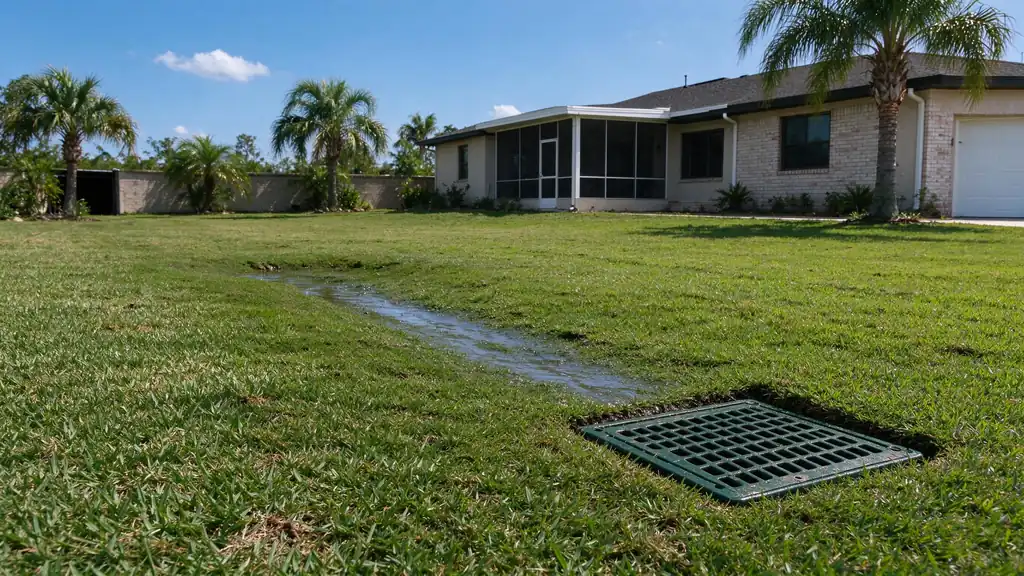
A catch basin receives surface runoff at a point; a French drain receives water through a permeable trench in the ground. Choose according to the water source and collection path, then confirm conveyance and a suitable receiver. They can sometimes work together, but neither creates outlet capacity simply by being added to a yard.
The parent catch basin service and French drain service describe the installation scopes. This comparison helps distinguish their jobs before a quote is developed. A box with a grate and a buried trench may share a discharge line while requiring different placement, materials and maintenance.
Follow surface water to a point inlet
A basin needs surrounding levels that deliver runoff to its grate. A low area can be a sensible investigation point, but its visible depth does not establish the right inlet level or destination. Raised edging, turf and paving transitions can bypass a correctly connected basin if they keep water from reaching it.
The basin assembly also needs to suit use of the area, including loading where vehicles are involved. Accessible sediment storage can keep some carried material out of the connected line, but it needs cleaning. A product’s dimensions should be compared with its role and installation support rather than treated as a complete drainage design by themselves.
Locate the subsurface water path
A French drain relies on water entering through surrounding filter and aggregate into its collection route. It should intersect the relevant water movement within the ground. Fast runoff crossing a patio may need surface interception instead; it cannot be assumed to enter a buried collection zone in time to address the same situation.
The surface-versus-subsurface guide explains this broader distinction. Soil compatibility, depth and receiving conditions matter. A perforated pipe without a suitable collection boundary is not enough. Nor is a deeper trench automatically better if it misses the relevant water layer or ends below a usable discharge level.
Combine only with a clear connection plan
A property can have both surface runoff and soil-water collection needs. A combined design should state where each source enters, which pipe receives ground water and which carries already-collected water. The pipe-function guide explains why solid conveyance and perforated collection are not interchangeable.
An unspecified connection can release concentrated basin runoff into the soil beside the original wet area. Shared junctions also need suitable access. Ask how the arrangement preserves each collector’s purpose and how a future blockage can be investigated without excavating the entire route. A diagram that merely joins all pipes together leaves important behavior unexplained.
Compare cleaning and sediment control
A basin can collect leaves, mulch and soil that arrive over the surface. Its accessible storage needs attention, and upstream erosion may need correction if material returns quickly. A French drain’s buried collection boundary should limit inappropriate sediment entry, but it is not maintenance-free. Its effectiveness can change even when the connected pipe remains open.
The maintenance guide separates accessible tasks from investigation. For recurring trouble, the repair service can compare cleaning, local defects and wider route problems. Avoid assuming that a blocked basin proves the French drain failed or that an open pipe proves the subsurface collection zone still works as intended.
Check the shared outlet before adding collectors
Both methods remain dependent on conveyance and receiving conditions. Several basins and a long trench connected to one restricted or submerged outlet may all back up together. More collection does not lower receiving water or establish permission to use a public drain. The destination must be part of the comparison from the beginning.
Read the no-gravity-outlet guide and permit guide for those decisions. Infiltration is another conditional receiving mechanism, not something every French drain automatically provides. If a proposal relies on the surrounding ground accepting water locally, ask for the site evidence and overflow explanation.
Compare a complete installation scope
An estimate should identify collection locations, materials, connections, access, outlet and restoration. A basin product price and a trench per-foot figure do not describe equivalent work. The cost guide retains national context only where supported and does not invent a local basin band to make the comparison look more precise.
Use the estimate checklist to compare the water problem addressed and the finished property. The inspection service is useful when source or route is unresolved. Choosing a method after those facts are established is more defensible than selecting the cheapest visible component and trying to make the property’s water fit it.