
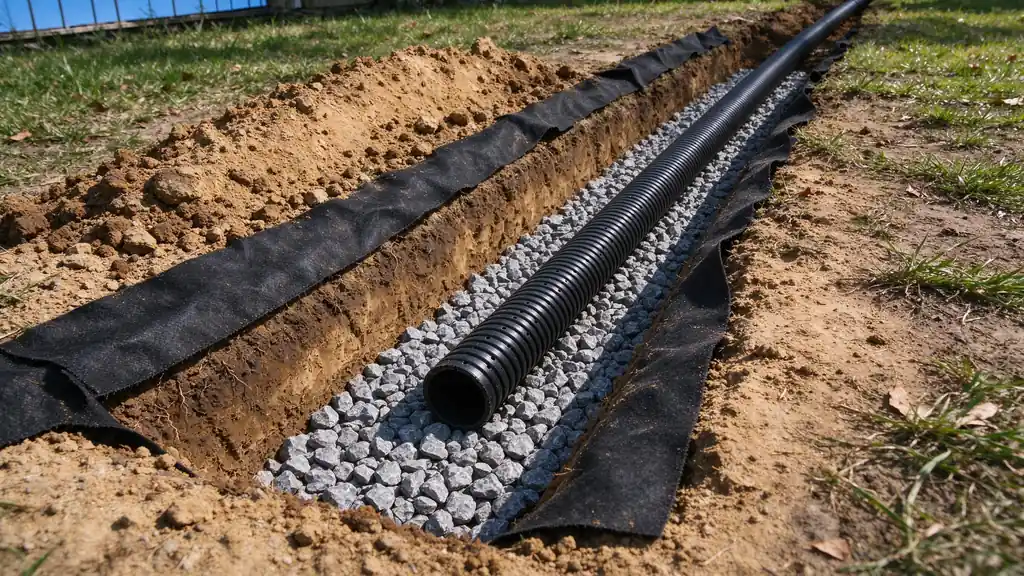
Choose a surface drain for water moving across the ground and a French drain for a suitable water path within the soil. Neither choice works without a viable receiving route. In Corpus Christi, establish the source, ground conditions, elevations and outlet before choosing a collector or combining the two methods.
The distinction is about how water enters, not which product sounds more substantial. Quay’s yard drainage service considers the complete route, while French drain installation concerns a permeable collection zone. A grate connected to pipe and a buried perforated pipe can look similar on a simple sketch while serving different mechanisms.
What a surface collector receives
A catch basin receives runoff at a point reached by the surrounding surface. A channel receives it along a line, such as a crossing on hardscape. A swale routes water across shaped ground. Each relies on surface levels delivering water to the intended place. A grate set higher than the adjacent low area can be bypassed even if its connected pipe is clear.
Use catch basin installation and channel installation to compare the different inlet geometries. Consider leaves, sediment, pedestrian use and vehicle loading where relevant. The support around an inlet and the practical ability to remove its cover are part of the installation, not details that can be left until the product has been chosen.
What a French drain receives
A French drain uses a permeable trench and compatible surrounding material to receive water from the ground. Filter, aggregate and pipe need to work with the actual soil. A buried pipe with holes does not by itself establish a useful collection zone. The trench must intersect the relevant water path and connect to somewhere that can accept what it receives.
It is not automatically a fast surface-runoff inlet. Water crossing paving may pass over or beside a subsurface installation without entering quickly enough to address the observed problem. The catch-basin comparison explains why combining methods can sometimes be appropriate, but only when each has a defined job and the shared conveyance and outlet remain suitable.
Identify the water before choosing
Record whether water appears during rain, remains after surface runoff stops or persists during dry weather. Show the contributing roof outlets, paving and higher ground where safely visible. A single photograph of a puddle cannot tell you whether surface collection, subsurface interception or another source investigation is needed. The standing-water guide provides a useful record.
Infiltration claims require separate evidence. A French drain that carries collected water to an outlet is different from a dry well relying on surrounding ground to accept stored water. A sandy surface does not establish conditions at the proposed depth. Keep the dry-well guide alongside the comparison when a proposal depends on infiltration rather than conveyance.
Explain where the systems connect
Surface water already collected in a basin or channel generally needs solid conveyance to its receiver. Perforated collection pipe has a different role. An unspecified connection can release concentrated runoff into the soil beside the original problem. Ask where collection ends, where solid conveyance begins and how mixed sources join without defeating either function.
The pipe-function guide describes those transitions. Shared junctions should remain understandable and maintainable after backfill. If several collectors use one outlet, their number does not establish its capacity. A restricted or submerged receiver can limit all of them, even when each collector is correctly placed and individually clear.
Let the outlet change the comparison
Measure the available fall along the whole proposed route. A deeper trench is not automatically better if it leaves the pipe below a usable discharge level. Observe receiving conditions during the problem where safe. The no-gravity-outlet guide explains why pumping, infiltration and storage need their own evidence and responsibilities.
Public connections, grading and right-of-way work may also affect the available method. Confirm the applicable approval questions for the actual property rather than assuming a nearby inlet is authorized. A method comparison that omits the receiving side is incomplete, however detailed its product descriptions may be.
Compare maintenance and finished scope
Surface inlets need accessible covers and removal of debris that reaches them. Subsurface systems need a collection zone that resists inappropriate sediment entry and a route that can be maintained. Neither is maintenance-free. Ask which parts remain accessible and how future paving or planting could affect the system.
The maintenance guide and cost guide help compare the complete purpose, restoration and ongoing work. A national per-foot range is not a local quotation or evidence that one method fits every site. Use a written proposal to compare the source addressed, installation, outlet, testing and finish. Request an assessment when those facts are still unresolved rather than selecting by price or product name alone.