
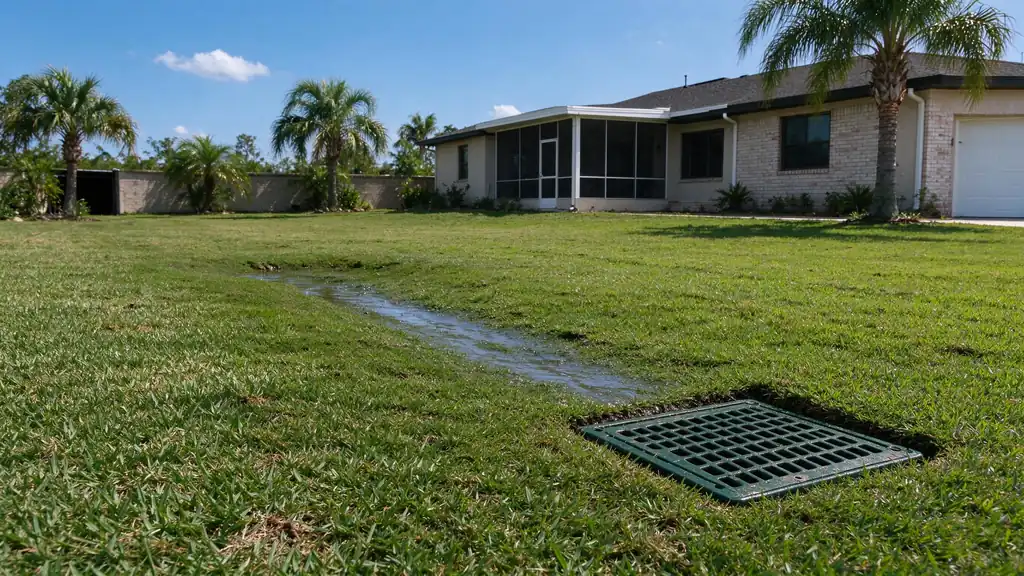
Use these drainage guides to resolve a decision, not simply to choose a product. They explain water sources, collection methods, pipe functions, receiving limits, project preparation and maintenance. Quay offers private-property drainage in Corpus Christi; the guides keep sanitary sewer work, structural repair, municipal civil construction and flood-protection promises outside that scope.
Start with the complete Corpus Christi drainage guide when several questions overlap. It follows the source-to-receiver path and connects the individual topics. If you already know the decision that needs attention, use the groups below and return to the relevant service page when an assessment or installation scope is needed.
Identify the water and the collector
Standing water after rain explains how to record timing, sources and recession safely. It helps prepare an assessment without diagnosing a property from a puddle. Stormwater versus sewer separates rainfall runoff, sanitary wastewater and supply-water questions so an unsuitable trade scope is not developed around the wrong system.
French drain versus surface drain compares water crossing the ground with a suitable subsurface collection path. Catch basin versus French drain focuses on a point inlet and permeable trench. Both comparisons explain why collector choice remains dependent on a usable receiver rather than the product’s name or size.
Follow the pipe to its receiving point
Solid versus perforated pipe explains collection and conveyance. A roof outlet or basin can release concentrated water into an unwanted location if connected to unspecified perforated pipe. The guide also covers transitions, materials, fall and cleaning access without prescribing a universal pipe specification.
Drainage with no gravity outlet compares verified fall with conditional infiltration, storage and pumping. A larger collector does not create a lower receiver. Private drainage versus coastal flooding keeps lot improvements separate from public-system capacity and elevated coastal receiving water.
Evaluate infiltration with evidence
Dry wells and rain gardens distinguishes storage, ground acceptance and overflow. It explains why a sandy surface or a neighbor’s installation is not enough to select a system. Actual location, depth, soil layers and groundwater conditions need consideration before an infiltration feature becomes the assumed destination.
The relevant service may be yard drainage, French drain installation or grading and swales, depending on the source and proposed mechanism. Do not assume every permeable trench disposes of water locally; some collect and convey it to a separate receiver.
Resolve boundaries and approvals
Neighbor runoff helps document cross-boundary flow, records and receiving questions without assigning legal responsibility. Historical routes and easements can affect a proposal. A private collector should not merely transfer the problem to another property or depend on access no one has agreed to provide.
Drainage permits and outlets distinguishes project and jurisdiction questions, including Corpus Christi grading, public right-of-way, qualifying island work and construction groundwater discharge. Portland uses its own authority. The guide raises questions for confirmation rather than making a permit determination for an unseen property.
Prepare installation and compare price
Installation and restoration explains access, utility coordination, connections, checks, backfill and the finished property. Turf, planting and paving are different restoration inclusions. A controlled water check demonstrates limited behavior under its conditions, not every-storm protection.
The estimate checklist compares source, route, receiver, assumptions, approvals and finish. Drainage cost retains national ranges only where supported and avoids invented local bands. It includes scope factors and illustrative arithmetic so a budgeting reference is not mistaken for a complete quotation.
Maintain and investigate existing work
Drainage maintenance covers accessible collection, safe discharge observations and recordkeeping. It explains when recurring trouble needs more than ordinary debris removal. French drain not working separates collection failure, conveyance problems and receiving limits before cleaning or replacement is chosen.
Those topics connect to drainage repair and inspections. A recurring symptom does not automatically justify a full replacement, and an open pipe does not prove that a buried collection zone still functions. Keep the recommendation tied to findings and clearly stated limits.
Carry the decision into a real request
The planning tools provide limited budgeting and observation routing, while the worksheet preserves notes and comparisons. Neither replaces site evidence or official safety guidance. If you request an estimate, describe the situation and known constraints through the shared form.
You do not need to read every guide or diagnose the system first. Use the topic that answers your current question, retain unresolved matters for the assessment and compare a complete scope before authorizing work. Appointment, price and start arrangements remain separate from an accepted online request.
When a guide links to another topic, follow the link only as far as the current decision needs. A roof-water request may need pipe-function and receiver explanations without requiring a complete infiltration comparison. Keep questions that remain unresolved in the assessment record rather than trying to turn every guide into a self-diagnosis checklist.