
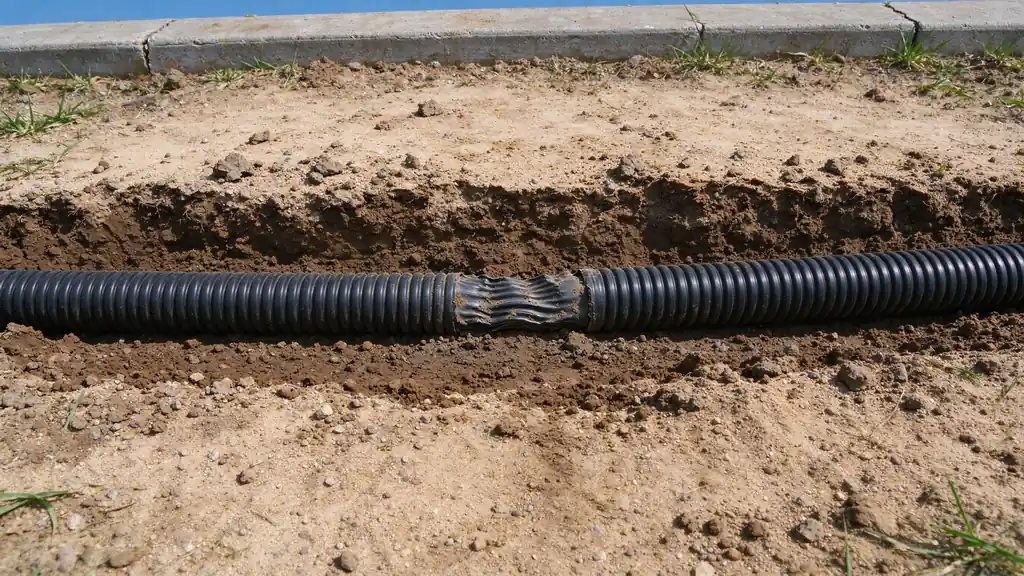
Keep accessible grates, basin storage and visible discharge points clear, and record how the route behaves after rain from a safe location. Repeated blockage, damaged parts or several backed-up inlets can indicate more than routine cleaning. Maintenance does not require entering unsafe water or opening structures you cannot handle safely.
This guide supports drainage repair and the complete planning guide. The right tasks depend on the installed system and product instructions. A catch basin, channel and French drain have different collection mechanisms, so maintenance should follow what is actually present rather than a generic instruction to flush every pipe.
Know the installed route
Retain any plan, photographs or handover record showing collectors, connections, cleaning points and the receiving outlet. If the route is unknown, avoid assuming that adjacent covers serve the same line. Later landscaping or paving can hide access and change surface flow. A useful record helps future work protect the system instead of accidentally disconnecting or burying it.
The installation guide explains what to request at handover. Distinguish an installation sketch from a certified survey or engineered document. If information is incomplete, an inspection can identify what is accessible and what further investigation may be appropriate before maintenance methods are selected.
Check accessible surface collection
Leaves, mulch and loose soil can reduce the open area of a grate or collect inside an accessible basin. Remove material only where the cover and work can be handled safely and consistently with the installed product. Do not force an unfamiliar cover, reach into an unknown structure or work in contaminated water to complete a maintenance task.
A basin may provide storage for sediment, but that space needs to remain accessible. Channels likewise need removable covers where intended. The basin service and channel service explain the components. If debris returns quickly, consider the upstream source rather than assuming that increasingly frequent cleaning is the only response.
Keep the surface approach open
Water must reach a collector before it can enter. Raised edging, turf buildup, a new bed or paving changes can divert runoff around an otherwise clear inlet. Look for changed surface routes as well as visible debris. A grate set outside the actual path may not be a pipe-cleaning problem at all.
The yard drainage service covers those connections between surface and buried work. Avoid adding soil or cutting a swale as an unplanned maintenance adjustment; changed levels can affect buildings, boundaries and receiving routes. If a surface alteration appears necessary, define it as a project decision with appropriate assessment rather than a routine cleaning task.
Observe discharge safely after rain
Where the outlet is visible from a safe place, note whether it discharges during the same event that fills the collectors. A dry-weather view alone does not reveal receiving-water backup. If several connected inlets remain full together, record that pattern. It may indicate a shared conveyance or receiving limitation rather than separate failures at every grate.
The no-gravity-outlet guide and coastal-limit guide explain those conditions. Never enter a flooded ditch, moving water or an unsafe public area to clear or photograph an outlet. Public infrastructure concerns belong with the responsible authority, not an improvised private maintenance operation.
Recognize recurring failure
Repeated restriction can involve sediment entry, roots, damage, unsuitable fall or inaccessible components. A French drain may also lose collection effectiveness even when its pipe is open. The failed-system guide separates collection, conveyance and discharge. Do not assume every recurrence means the installation needs full replacement or that cleaning will always restore its intended purpose.
A repair assessment should identify what evidence supports the proposed method. Ask what can be checked through existing access and whether further opening is needed. Cleaning equipment and methods should suit the installed materials and condition. No particular tool is prescribed here for every private drain, and a visible symptom should not be treated as proof that a forceful cleaning approach is appropriate.
Keep a useful maintenance record
Note the date of observations, rainfall context, affected collectors, material removed and any visible damage. Keep photographs from consistent safe viewpoints where practical. A simple sequence can help distinguish a new source, a changed surface route and a recurring buried restriction. Avoid claiming a precise cause when the record only shows where water stood.
Use the standing-water worksheet guidance and resources page to organize information. If professional work is needed, describe the pattern through the shared estimate form. The cost guide does not promise a universal maintenance fee; access, condition, cleaning scope and any repair or restoration need to be identified before price comparisons are meaningful.