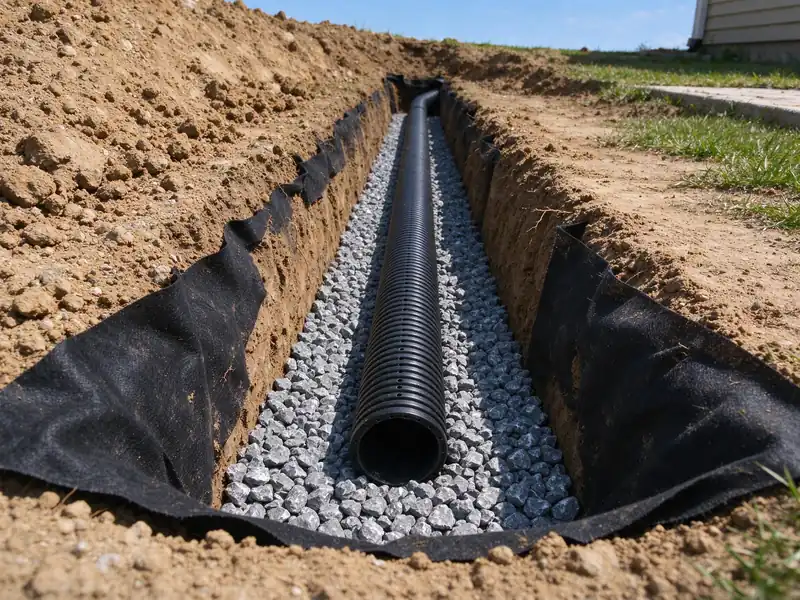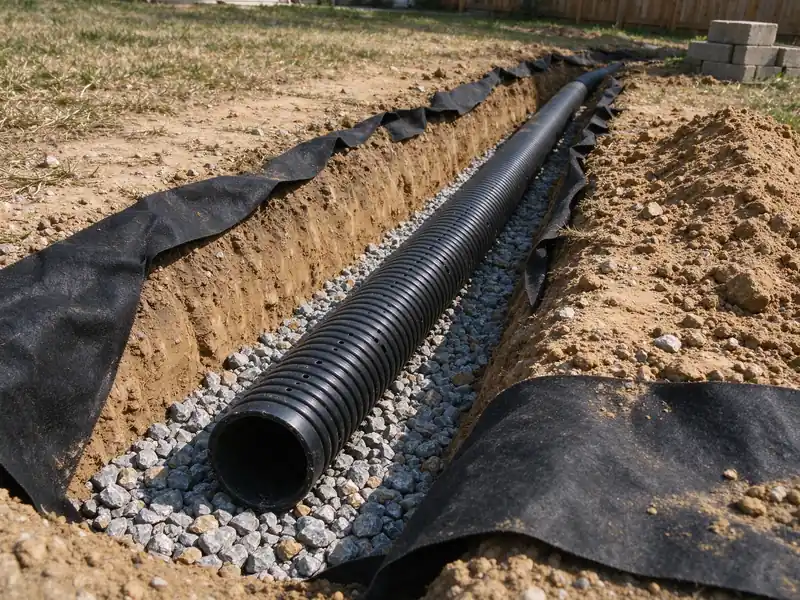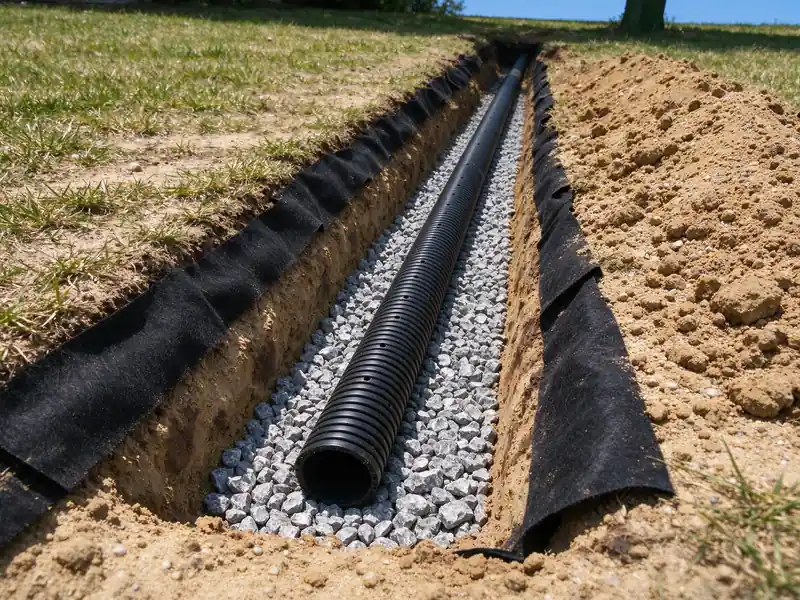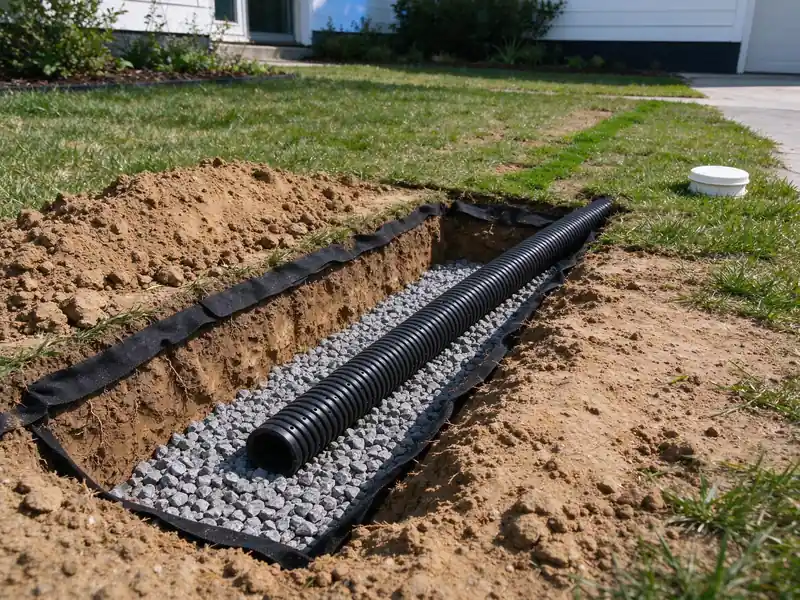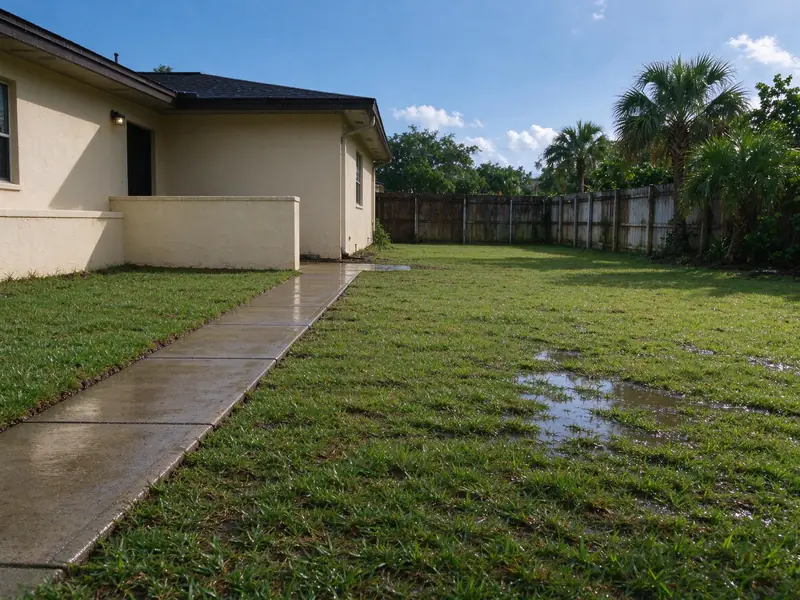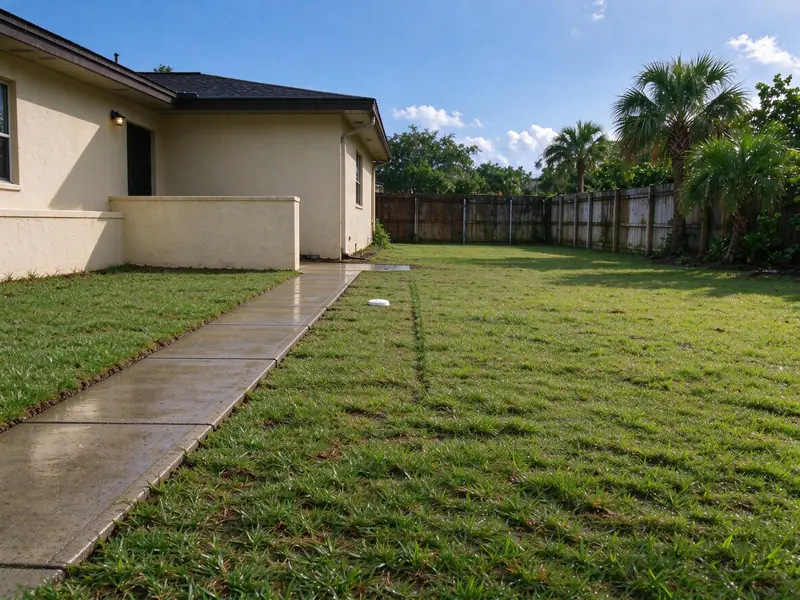
Water that stays in the soil needs a different collection method from runoff crossing a patio. Quay Corpus Christi Drainage offers French drain installation in Corpus Christi for properties where a permeable collection trench has a defined job. The proposal should connect that trench to a receiving route that can actually accept its water.
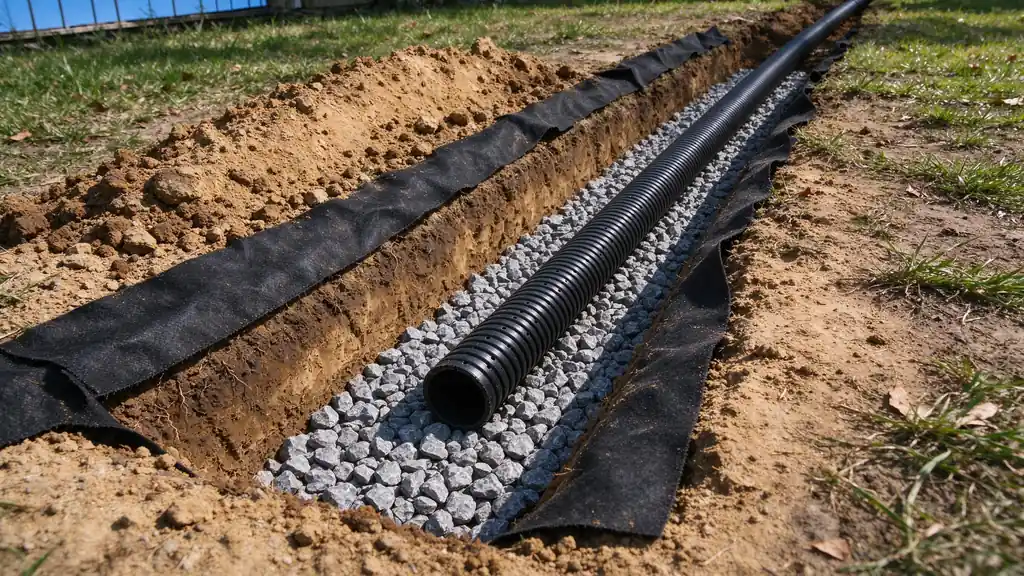
A French drain is not simply a buried pipe with gravel around it. Soil conditions, filter compatibility, elevations and the outlet determine whether water can enter, travel and leave. If rain is racing across the surface, a catch basin or grading approach may belong in the plan instead. Choosing the collector comes after identifying the source.
When a French or curtain drain fits
A French drain receives water through a permeable trench within the ground. It can intercept shallow subsurface movement before that water reaches a persistently wet area. A curtain drain is an interception arrangement placed across a water path; it is not a separate cure for every soggy lawn.
Look at when the problem begins. Water appearing during rain, remaining after nearby surfaces dry, or arriving from higher ground raises different questions. Dry-weather water can also involve irrigation or a supply-water problem. A wet patch alone does not identify the source, and installing a collector before checking it can leave the actual fault untouched.
The surface-versus-subsurface comparison explains that distinction. A perforated pipe below ground does not provide the same immediate surface opening as a grate. Some properties need both, but each component needs its own collection purpose rather than an assumption that more pipe means more drainage.
What to establish at the property
A useful assessment identifies the water source, the intended collection zone, the available route and the receiving point. Ask which elevations will be measured and how the proposal accounts for a receiving outlet that backs up during rain. A route that appears downhill by eye may still include an uphill section or end below the receiving water.
Existing surfaces matter too. Fences, gates, planting beds, air-conditioning equipment and buried services can determine how excavation reaches the proposed line. Identify known irrigation, private electrical lines and other private utilities separately from public utility markings. Do not dig exploratory holes yourself to find them.
Bring photographs taken safely at different stages of rainfall and any information about earlier drainage work. Our inspection scope and estimate checklist describe the questions to put into a written proposal. Neither a photograph nor a neighborhood description replaces checking the actual ground and outlet.
Build a collection zone that stays useful
The surrounding drainage material receives water before the pipe carries it away. Filter fabric, aggregate and the adjacent soil need to work together: a filter that passes the wrong soil particles can admit sediment, while an unsuitable arrangement can restrict water before it reaches the pipe. Specifying fabric by appearance or calling all gravel interchangeable does not settle that decision.
The proposed trench should have a clear extent and purpose. A short interception section across a known source is a different scope from a long collection line around a wet area. Excavation depth also affects nearby structures and utilities. A deeper trench is not automatically more effective, especially if it removes usable fall to the discharge point.
Ask the contractor to identify the collection material, pipe type and connections in the estimate. Where a proprietary aggregate-free system is proposed, its product instructions and ground suitability matter. A product substitution should be evaluated against the job conditions rather than treated as a price-only swap.
Give collection and conveyance different jobs
Perforations allow water to enter a collection pipe. After the collection zone, solid pipe may be appropriate for carrying that water between points without intentionally releasing it along the route. The solid-versus-perforated pipe guide helps explain why those sections should be identified separately.
Roof water creates another connection question. Concentrated downspout flow should not be sent into a subsurface trench by default. Check the intended connection, the receiving capacity and how either section can be cleaned. A blocked roof-water connection can otherwise look like a French drain failure even when the collection trench is functioning.
The plan should preserve access at useful locations, account for bends and show where the water is expected to go. If the receiving point is too high, adding trench length does not create gravity fall. Pumping or infiltration may require separate assessment, approvals and maintenance; neither is automatically included in French drain installation.
Get an Estimate
Tell us what happens, where the property is and what access or outlet information you have. A request does not confirm an appointment or price.
Resolve the outlet and approvals before excavation
A private drainage proposal is not permission to cut a curb, work in a public right of way or connect to a public system. Establish the proposed receiving point and the authority responsible for it. Applicable approval requirements depend on the property and project, not merely on the pipe being inside a yard.
The City of Corpus Christi separately addresses groundwater discharge during construction. That authorization process is not blanket permission for a permanent yard-water outlet. Keep temporary excavation pumping and the finished system’s discharge decision separate.
See permits and outlets for the project questions. Quay’s scope is private-property drainage, not municipal civil construction, sanitary sewer repair or structural foundation repair. The selected contractor’s qualifications and responsibilities should match the actual work and any permit requirements.
Put testing and restoration into the scope
Before backfill hides connections and pipe support, the work should be checked against the agreed layout. Ask how accessible collection, conveyance and discharge will be observed, which conditions that check represents, and what remains dependent on future rainfall. A limited water check is not proof of performance in every storm.
Restoration needs more detail than “leave tidy.” Confirm who handles surplus soil, settlement allowance, turf, irrigation repairs, paving and planting-bed reinstatement. A trench through lawn and a route beneath concrete can have similar lengths but very different restoration costs. Keep exclusions and provisional items visible in the proposal.
Our installation and restoration guide follows those handoffs. The practical goal is a defined water route with serviceable access and an agreed finish, rather than a buried line whose outlet and maintenance arrangements remain unknown.
Compare costs by matching the work
A national budgeting range for exterior French drains is $10–$50 per linear foot. It is not a verified Corpus Christi installed price or a Quay rate. Depth, access, collection materials, outlet work and restoration can change the scope materially, so multiplying a length alone does not produce a complete project quote.
| Choice | What it changes | What to confirm |
|---|---|---|
| Targeted interception | Collection is concentrated across an identified water path | Whether other sources remain untreated |
| Longer collection zone | More excavation, material and maintenance access | The demonstrated reason for its extent |
| Surface collection alongside the trench | Receives runoff that may never enter the ground in time | Separate inlet and conveyance capacity |
| Hardscape crossing | Adds cutting, support and surface replacement | The finish and any movement-joint details |
Use the cost guide to compare like scopes. Where insurance is involved, ask the insurer about the actual cause and policy terms; a drainage improvement is not automatically covered. No installation rebate is assumed in these budgets.
Keep the route serviceable
Record where the collector, cleanouts and receiving outlet are located. Keep soil, mulch and planting from burying accessible points, and observe changes from a safe place after rain. Repeated water accumulation may involve sediment in the collection zone, damaged pipe, incorrect fall or a receiving-water problem. Those failures need different responses.
The failed French drain guide explains why wholesale replacement should follow findings, not just the age of a line. If you want to discuss a new installation or a recurring wet area, request a drainage estimate with the water pattern, access constraints and any existing outlet information.